
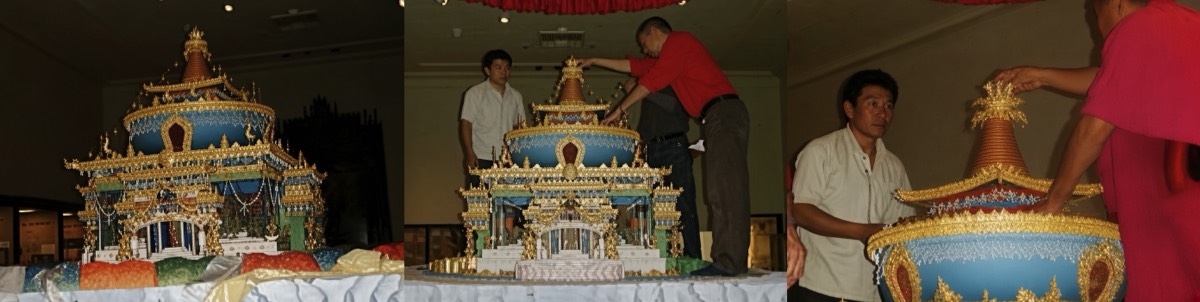
| Shi-tro Mandala for Universal Peace | ||
The Shi-tro Mandala for Universal Peace project is sponsored by T'hondup Ling, the Los Angeles center of Chagdud Gonpa Foundation (a non-profit Buddhist organization), and involves a rare three dimensional Tibetan sculpture called the Shi-tro Mandala for Universal Peace. The project was conceived by T'hondup Ling's resident Lama, Lama Nubpa Chodak Gyatso, to preserve a vital part of the vanishing Tibetan sacred culture and to function as a focal point for a formal peace and non-violence curriculum. This traditional Tibetan Mandala is the first of its kind to be constructed in the United States, and measures eight feet in diameter and twelve feet in height.
Blessed by the Dalai Lama in June of 2000, construction of the Shi-tro Mandala was completed in November of 2000 after nearly one year of construction at Forest Lawn, Glendale. The Mandala is currently being shown at the Pacific Asia Museum in Pasadena as the central piece in an eight-museum citywide exhibition celebrating the theme The Universe (February - May 2001).
Though often made by sprinkling sand on a flat surface, all mandalas are three-dimensional, with sand mandalas only hinting at the top view of a dazzingly elaborate creation. Due in part to the large commitment of time, expertise and funding needed to create three-dimensional mandalas, there are only a few in the world. Requiring months to build, such mandalas, unlike sand mandalas, are not dismantled upon completion. Their multilayered symbolism conveys spiritual meaning for years to come.
Only a handful of artists in the world possess the vast esoteric knowledge of Buddhist ritual, symbolism and philosophy that is needed to create a three-dimensional mandala. By supporting and documenting their work, we can help preserve this ancient culture that continues to be threatened by extinction.
It is well documented that all but a few of Tibet's 6000 monasteries were destroyed and that more than 1.2 million Tibetans perished during the Communist Chinese occupation. His Holiness the Dalai Lama, venerated worldwide for his tireless efforts on behalf of peace and nonviolence, led the flight in to exile of thousands of Tibetans who now live in India, Nepal and Bhutan. One of the primary goals of His Holiness has been the preservation of sacred Tibetan art and culture, which he believes can benefit the people of all nations and cultures.
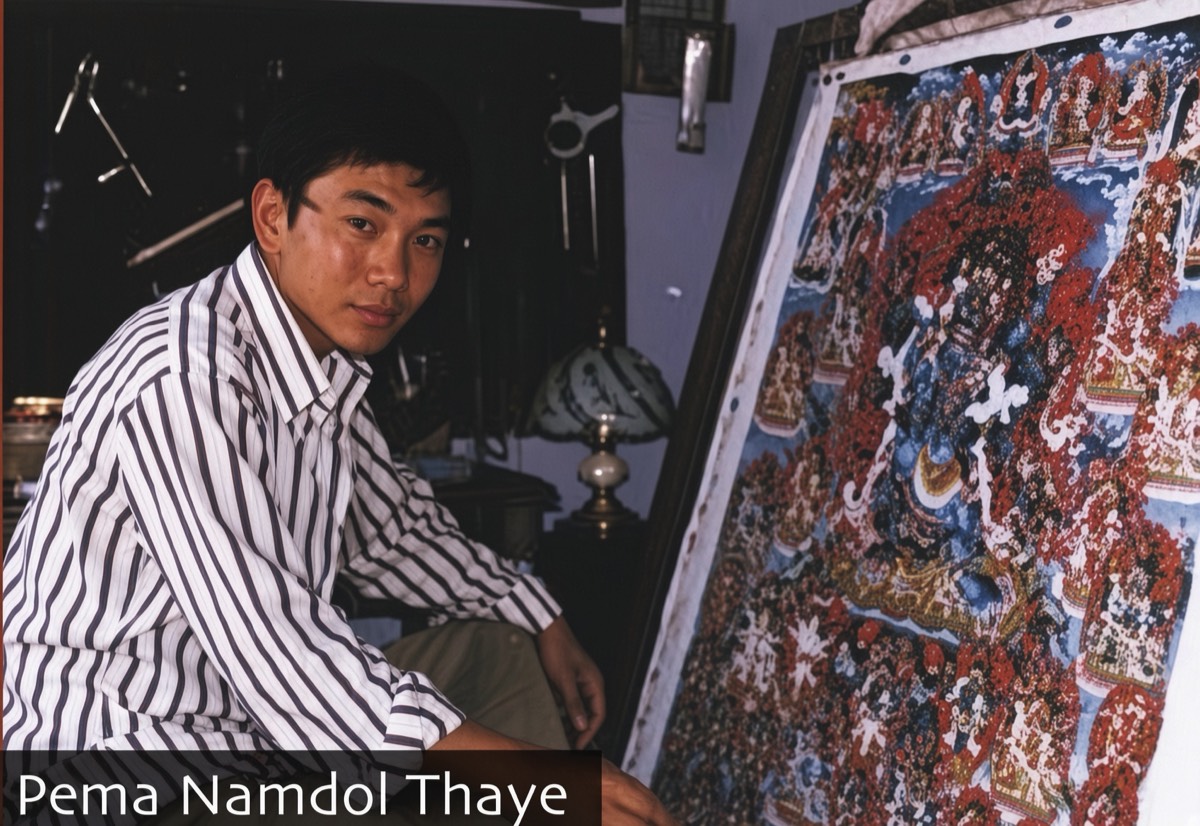
It is well documented that all but a few of Tibet’s 6,000 monasteries were destroyed and that more than 1.2 million Tibetans perished during the Communist Chinese occupation. His Holiness the Dalai Lama, venerated worldwide for his tireless efforts on behalf of peace and nonviolence, led the flight into exile of thousands of Tibetans who now live in India, Nepal, and Bhutan. One of the primary goals of His Holiness has been the preservation of sacred Tibetan art and culture, which he believes can benefit the people of all nations and cultures.
| About the Shi-tro Mandala The Shi-tro Mandala depicts the peaceful and wrathful deities of the One Hundred Buddha Families (“Shi-tro” in Tibetan), which are expressions of enlightened qualities that have the power to transform negativity and promote well-being and spiritual development. “Wrathful deities” are not in any way expressions of our ordinary emotional confusion; rather, the vast array of such deities is simply a direct expression of the innate power of compassion that tames our emotional negativity. Each aspect of the mandala and deities is highly symbolic and is intended to awaken these qualities in the viewer. There are also ceremonies based on this secret mandala that benefit the deceased, freeing their minds of fear in the after-death state, or bardo. When the mind recognizes the bardo for what it is, all perceptions based on confusion are recognized for what they truly are—the peaceful and wrathful deities that are expressions of self-knowing intrinsic awareness—and one gains liberation from cyclic existence. The ceremonies for the deceased are very sacred methods to purify their consciousness and lead them further along the spiritual path. This mandala is being built from the sacred tradition of Tibetan Buddhism to create harmony between the inner cosmos of the mind and the outer universe that we share. |
| About the Shi-tro Mandala The Shi-tro Mandala depicts the peaceful and wrathful deities of the One Hundred Buddha Families ("Shi-tro" in Tibetan), which are expressions of enlightened qualities that have the power to transform negativity and promote well-being and spiritual development. "Wrathful deities" are not in any way expression of our ordinary emotional confusion; rather, the vast array such deities is simply a direct expression of the innate power of compassion that tames our emotional negativity. Each aspect of the mandala and deities is highly symbolic and is intended to awaken these qualities in the viewer. There are also ceremonies based on this secret mandala that benefit the deceased, freeing their minds of fear in the afterdeath state, or bardo. When the mind recognizes the bardo for what it is, all perceptions based on confusion are recognized for what they truly are - the peaceful and wrathful deities that are expressions of self-knowing intrinsic awareness - and one gains liberation from cyclic existence. The ceremonies for the deceased are very sacred methods to purify their consciousness and lead them further along the spiritual path. This mandala is being built from the sacred tradition of Tibetan Buddhism to create harmony between the inner cosmos of the mind and the outer universe that we share. |